
Where CCDC Releases Go
Charles County Detention Center holds pretrial and sentenced adult men and women for the Charles County Sheriff’s Office Corrections Division. Leaving this building has more than one meaning. Personal recognizance, bond, electronic monitoring, time served, sentence expiration, dismissal, or another court-authorized status may place a person in the community. Transport to Maryland DOC, another county, the U.S. Marshals Service, BOP, or ICE continues custody. A hospital movement may also occur while detention remains in force.
The key is destination. A Maryland Incarcerated Individual Locator match after a person leaves CCDC points toward a state transfer, not a county release. A federal or ICE record may establish another custody lane. By contrast, a CCDC discharge entry paired with VINE status and a court order can document an actual community release. Absence from a web page cannot do that because CCSO publishes no verified live roster or release archive.
| CCDC exit | What it means | Best confirmation |
|---|---|---|
| Bond, recognizance, or monitoring | Possible community release under court conditions | Court order plus CCDC discharge entry or VINE |
| Time served or sentence expiration | Possible end of county confinement | Sentencing record and actual release record |
| Maryland DOC transfer | State custody continues | DPSCS locator, commitment, and receiving record |
| Federal or ICE transfer | Another custody system may continue detention | BOP, ICE, federal court, USMS, or agency record |
Confirm a CCDC Release
No official CCSO roster, 24-hour list, 72-hour list, historical release search, or jail-information app was verified. Confirmation therefore requires a short evidence chain. The full Charles County released-inmate search path is available on the home page, while the steps below focus on a known CCDC booking.
- Collect the legal name, date of birth if known, approximate booking date, case number, and booking number if available.
- Search Maryland VINE by name or offender number. Compare identifiers and note any custody location or release information.
- Read Maryland Case Search for the bond review, release conditions, disposition, sentence, commitment, or modification.
- Call CCDC and ask whether the person remains confined and whether any recorded exit was a discharge or transfer.
- Check the correct receiving system when transfer is possible. DPSCS, BOP, and ICE each cover different custody.
- Request the existing booking and release portions of the CCDC record when documentary proof is needed.
CCDC Release Contacts
The official detention page and CCSO directory publish two nearby CCDC phone numbers. Both should remain attributed because the official sources disagree. Facility staff handle present-custody direction. The Records Section handles documentary requests, while the court clerk supplies the judicial order. DPSCS does not manage Charles County local-detention records.
Charles County Detention Center
6905 Crain Highway
La Plata, MD 20646
Detention page: 301-932-3101
CCSO contact directory and county directory: 301-932-3100
CCSO Records Section
6915 Crain Highway, P.O. Box 189
La Plata, MD 20646
Records: 301-609-6404
Requests: CCSO Access Public Records
Ask the facility a narrow custody question. Ask Records for the existing record. Neither contact should be asked to create a custom recent-release list that the agency does not maintain for public display.
CCDC Custody and Capacity
CCDC is the only verified adult correctional facility physically in Charles County. Official material assigns the Corrections Division central processing, booking, classification, transport and court holding, work-release responsibilities, and custody across security levels. A 2025 communications procurement describes 425 beds, ten general-population units, nine special-needs units, and a seven-cell booking area. The 2024 annual report describes a roughly 140,000-square-foot building with 219 cells.
Those measures describe one county detention complex from different operational views. They are not release totals. The annual report’s intake and population counts also should not be converted into an average stay or a count of people discharged. Each figure keeps the source’s own label.
CCDC Has No Release Feed
The official detention page provides facility and custody-service information, but research found no roster control, recent-release window, post-release retention period, or booking-photo gallery. Services such as visitation, communications, and account tools concern people currently detained. They do not establish that someone left custody.
The CCSO detention page is shown below as the source checked for CCDC information.
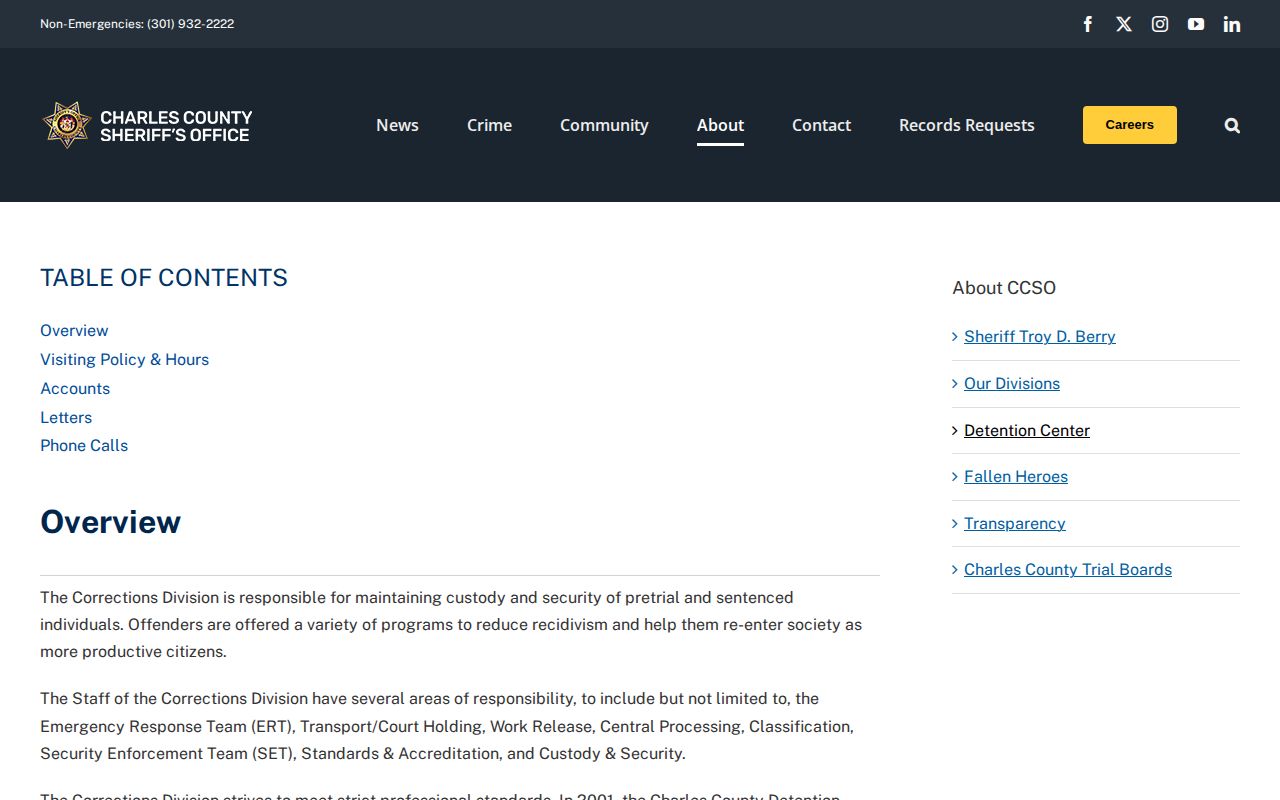
Its lack of a released-person control explains why VINE, direct contact, the court record, and the CCSO records portal form the practical route.
Do not substitute a third-party list. Nor should a CCSO press release be treated as an automated jail log. A story may report that a commissioner ordered unsecured bond or electronic monitoring, but the story documents that event only. Actual discharge still needs facility or agency evidence.
Request a CCDC Release Record
A focused request gives the Records Section a defined person, event, and date range. Identify the full name, date of birth if known, CCDC, approximate arrest or booking date, and case or booking number. Ask for existing booking or intake material and the portion that records the release date and time, release authority or type, and destination or receiving agency if recorded. Request electronic delivery and nonexempt portions if part of the file is withheld.
| Requested item | Why it matters |
|---|---|
| Booking number and admission time | Links the release to the correct custody event |
| Release date and time | Documents the processed jail exit |
| Authority or release type | Distinguishes bond, sentence end, monitoring, and other outcomes |
| Destination or receiving agency | Separates community release from transfer |
| Court or case number | Connects the jail event to the judicial record |
The published CCSO fee page lists set categories, but it does not promise a flat price or turnaround for a CCDC release record. The first two research hours are listed as free, with later time billed at a published minimum hourly rate. Wait for the portal’s invoice rather than assuming the cost.
Charles County Jail History
The current CCDC opened in 1995. Before then, a different building served as the county jail from 1981 through 1995. That older site reopened as an Annex in 2007 and later housed work-release activity. CCSO subsequently ended that program there and converted the structure to South Patrol District One.
This timeline matters when an old release record names the Annex. It does not show that Charles County now operates two adult jails. The former Annex history explains how to frame an archival request. Current custody questions belong with CCDC, while older requests should include the facility wording and approximate date that appear in the source record.
Historical CCSO reports also mention STARS, GED activity, reentry fairs, and work or school release. Current eligibility and program availability must be confirmed directly. Past program descriptions are not proof of a service offered to a person being released now.
CCDC Release Care Planning
CCDC’s health-services procurement contains concrete continuity requirements for releases involving a medical need. The contractor must use need-based transition planning, arrange a community-clinician referral when appropriate, exchange relevant health information, and address appointments and prescriptions. The document also calls for medication arrangements that can include up to a 14-day supply when the need applies.
These are contract duties, not a promise that every person receives the same services or medication. For a planned Charles County Detention Center release, the useful question is whether staff have identified a continuing-care need and what instructions, referral, appointment, prescription, or medication arrangement applies to that person. Personal medical details remain subject to privacy and authorization rules.
A family member should not infer a care plan from the release status alone. The person being released, authorized counsel, or another permitted representative can ask the appropriate medical or case-management contact about continuity steps before discharge. An emergency after release belongs with the proper health service, not the records portal.
Three CCDC Release Timestamps
Charles County records are clearest when three events remain separate: the court’s authorization, CCDC’s physical discharge, and any receiving agency’s intake. The first may appear in Maryland Case Search or the court file. The second belongs in the jail release record or a VINE custody event. The third may appear in DPSCS, federal, another county’s, or ICE records.
- Authorization
- A judge or commissioner permits release under stated terms. Processing may still remain.
- Discharge
- CCDC records the person’s actual exit from its custody event.
- Transfer intake
- Another agency accepts custody, showing that confinement continued elsewhere.
- Community release
- The person leaves physical detention, though court conditions or supervision may remain.
This sequence prevents a common error. A bond order is strong proof of legal authority, but not the gate time. A missing locator result is weaker still. Matching the three records produces a much firmer answer about where the person went.