
Charles County 24-Hour Releases
Charles County does not publish a verified rolling 24-hour release list. The official Charles County Sheriff’s Office channels were checked for a public inmate roster, booking list, recent-release page, archive, and release filter. None was found. The detention page offers services used by people who are still confined, but those links are not release-confirmation tools. There is also no official URL, set window, update schedule, photo display, or public retention period for a same-day release feed.
That fact changes the search. A person’s absence from a web page cannot prove release because there is no CCSO roster against which to test the name. The useful question is which official event occurred: a court authorized release, the Charles County Detention Center completed discharge, or another agency accepted the person into custody. Those events can occur at different times. The most reliable same-day check compares VINE, the court docket, and a direct facility inquiry.
The official Charles County Detention Center page shows the facility services that are actually published and contains no recent-release control.
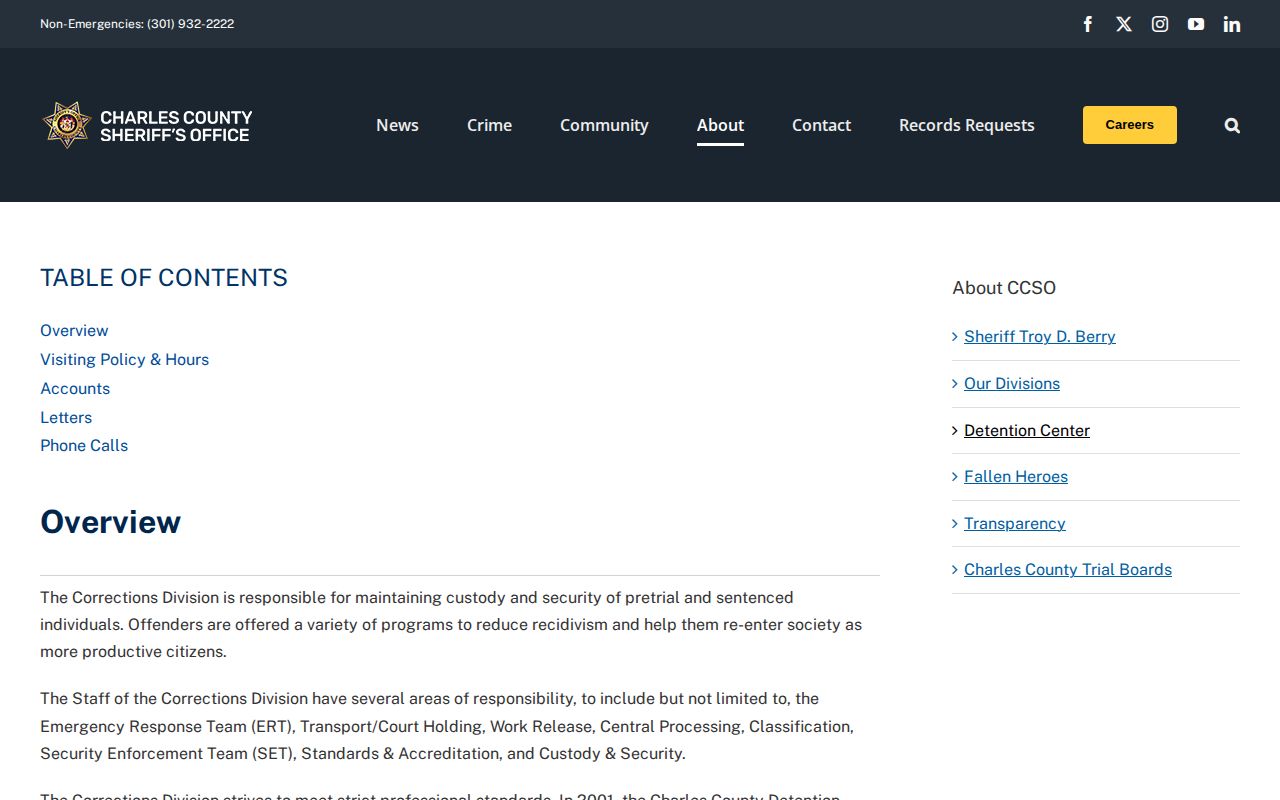
The captured page supports the correct fallback: use official custody, court, and records channels instead of treating a third-party list as a CCSO feed.
Check Charles County Same-Day Releases
Start with the last confirmed custody system. These steps are designed for a person last held at CCDC, the sole verified adult detention facility in Charles County. Keep the full legal name, date of birth if known, approximate booking date, case number, and any booking number together. Matching those details prevents a similar name from being mistaken for the right person.
- Search Maryland VINE by name or offender number. Compare identifiers and read the custody or release information rather than relying on a name alone.
- Call CCDC at 301-932-3101, the number on the detention page, or 301-932-3100, the number in the CCSO contact directory. Ask whether the person remains confined and whether a disclosed exit was release or transfer.
- Search Maryland Judiciary Case Search for the matching Charles County case. Review bond, release-condition, commitment, disposition, sentencing, and probation entries.
- When proof is needed, use the CCSO public-records portal to request the existing discharge entry for the named person and date.
- If the jail exit may have been a transfer, check the state, federal, or immigration locator that fits the receiving system.
VINE and CCDC address physical custody most directly. Court entries show legal authority and may post before staff finish identity checks, property handling, transport checks, or other discharge work. For a broader named-person search that reaches beyond today’s window, use the Charles County released inmate search. The same-day process should remain narrow and tied to one known booking.
Note: A no-result in a custody locator is a clue, not proof that the person entered the community.
Charles County 24-Hour Record Fields
Because no CCSO 24-hour feed exists, it shows no public fields. Do not assume that a name, booking photo, release time, or release type appears online. The table identifies fields worth requesting from an existing CCDC record. Maryland and Charles County publish no single field dictionary for jail discharge entries, so availability depends on what the agency maintains and what may lawfully be disclosed.
| Requested field | Why it matters |
|---|---|
| Full name and booking number | Ties the release event to the correct admission and avoids a same-name mismatch. |
| Booking date and time | Defines the custody episode being checked during the 24-hour period. |
| Release date and time | Documents when CCDC recorded the exit, if that field exists in the responsive record. |
| Release authority or type | May distinguish bond, personal recognizance, electronic monitoring, time served, sentence expiration, dismissal, or another basis. |
| Destination or receiving agency | May show that the exit was a transfer rather than community release. |
| Court or case number | Links the jail event to the order, charge, or disposition in the court file. |
A useful request asks for existing records, not an explanation created for the requester. It can seek the booking or intake portion and the discharge or disposition portion. If part of a record is withheld, ask CCSO to provide nonexempt portions that can be separated. A custom list of everyone released today should not be demanded because the agency need not create a new record that does not exist.
Court Orders and Actual Release
The Charles County District Court Commissioner station can make pretrial release decisions. Its official directory lists round-the-clock service at 11 Washington Avenue in La Plata. CCSO press releases also contain examples of unsecured bond and electronic-monitoring conditions. Yet those sources document a judicial decision, not the moment CCDC finishes discharge.
Use three timestamps when checking a Charles County release today: the court’s authorization, the jail’s discharge, and any receiving agency’s intake. A bond decision can occur first. The person may then remain at CCDC while processing continues. If a detainer or transfer applies, another agency’s intake may follow the county exit without any period of community release. Pair the commissioner record or docket entry with VINE, a facility response, or the release record.
A court result also needs careful wording. Dismissal or acquittal addresses the case, while discharge addresses physical custody. Release does not erase the charge history, and a pending case can continue after bond. These distinctions keep the same-day answer precise.
Note: Ask the court clerk for the specific order when the online docket summary does not show enough detail.
Charles County Release Feed Gap
The absence of a feed is distinctive local information. Some jurisdictions publish vendor rosters with preset time filters. Charles County instead publishes a detention-services page and an official public-records route. No CCSO 24-hour view, 72-hour view, release archive, public cadence, or post-release retention window was verified. An unrelated web page with “Maryland” or “24 hour” in its title does not establish a sheriff-controlled data source.
This gap also means there is no honest “what the feed shows” inventory. A page that displays names, dates, charges, or photos may be an arrest or booking list rather than a release list. Booking answers when custody began. Release answers when and why the person left, and whether the destination was the community or another custodian. When a wider date range is needed, the Charles County Jail Releases: 72 Hours process uses a date-bounded records request instead of an invented rolling list.
Charles County Jail App Limits
No public CCSO jail-information app was found. The agency’s Cordico announcement concerns an employee and family wellness tool. P3 is used for crime tips. Neither product provides a jail roster, inmate lookup, custody status, or same-day release feed. Installing either one will not answer who left CCDC today.
The CCSO press-release archive can offer case-specific leads. A story may include a photograph or say that a commissioner imposed personal recognizance, unsecured bond, or electronic monitoring. It remains an episodic news source. It is not a booking-photo archive and does not refresh as releases are processed. Treat a story as a pointer to the matching court case, then confirm the actual custody event through VINE, CCDC, or a discharge record.
Social posts have the same limit. They may report an arrest or an expected court step without recording the final jail exit. Official agency attribution helps establish the source, but it does not turn a post into a release ledger.
Request Charles County Release Records
The CCSO Records Section is the documentary fallback for a county detention release. Use the official Access Public Records page and follow its agency portal link. Identify the person, date of birth if known, CCDC, the approximate booking and release dates, and the case or booking number. Ask for electronic delivery of the existing booking and discharge portions, including release date and time, legal authority or type, and the destination or receiving agency if recorded.
The Records Section phone is 301-609-6404. CCSO lists headquarters at 6915 Crain Highway, P.O. Box 189, La Plata, MD 20646. Published fee categories include incident or event material, photos, video, audio, and research time, but CCSO does not publish a flat release-record price. It also gives no current release-record turnaround or retention period. The portal issues an invoice when charges apply, and records are released after payment.
Maryland’s Public Information Act applies to existing documentary material. It does not require the sheriff to answer broad questions, conduct new research, or construct today’s release list. A focused request is more likely to locate the right entry and avoid needless research time.
Released or Transferred from Charles County
Leaving CCDC can mean community release on bond, personal recognizance, electronic monitoring, time served, sentence expiration, dismissal, or another court-authorized status. It can also mean transfer to the Maryland Division of Correction, another county, federal custody, or immigration custody. A hospital movement may leave the person legally detained. The release record’s destination field, when maintained, is therefore as important as its date.
The DPSCS Incarcerated Individual Locator covers people currently housed in specified state facilities. A current state result after a CCDC exit points toward transfer, not community release. A no-result does not prove discharge because the locator excludes people no longer in covered custody and can omit some short sentences. Federal BOP and ICE systems have their own limited scopes, and neither substitutes for the county jail record.
For a permitted personal or court-related check, use the system that owns the event. CCDC confirms county custody. The court confirms its order. VINE may report a custody change. The receiving agency confirms continued confinement. The CCSO discharge record preserves the clearest local proof after same-day alerts change.