
Understanding Charles County Releases
A Charles County release is an event recorded by the agency that had custody. It is not just a name vanishing from a screen. The Charles County Detention Center may release a person to the community after bond, personal recognizance, electronic monitoring, time served, sentence expiration, dismissal, or another court-authorized status. The same person may instead leave the county jail in a transport vehicle and enter Maryland, federal, immigration, or another county’s custody. That movement is a transfer, not freedom from confinement.
The record source follows the custody path. Charles County Sheriff’s Office records document a CCDC booking and discharge. A Maryland prison commitment belongs to the Division of Correction. A court file may show the order that authorized bond, probation, or release, while VINE may report the related custody change. A person on parole can be outside a prison yet remain in legal custody until the full term expires. These distinctions prevent a missing roster entry from being treated as proof of community release.
- Discharge
- The agency event that ends a particular period of custody.
- Time served
- A sentence satisfied by time already spent in custody.
- Transfer
- Movement from one custodian to another without community release.
- Parole
- Conditional release approved through the Maryland Parole Commission.
- Probation
- Court-ordered community supervision, often tied to a suspended sentence.
Charles County Release Types
The legal basis matters because it determines what should appear next. A court order may authorize the jail to process a community release, but the order does not supply the exact gate time. A transfer record points toward the receiving custodian. Death or escape may also remove a person from a current locator, but neither is a community release. The safest account names the event shown by the source and avoids adding a broader conclusion.
| Release or movement | Meaning | Best next record |
|---|---|---|
| Bond or recognizance | Physical release while the criminal case continues | Court order plus CCDC discharge entry |
| Electronic monitoring | Community placement under stated conditions | Court conditions and jail release record |
| Time served or expiration | The custodial term has reached its end | Sentence, credit record, and discharge entry |
| Parole or mandatory supervision | Conditional release before the undiminished term ends | MPC order, VINE, and supervision record |
| Dismissal or favorable disposition | A charge ended as the court records | Docket or certified disposition plus discharge proof |
| DOC, federal, or ICE transfer | Custody continues with another agency | Receiving agency locator or transfer entry |
A Charles County court disposition and a CCDC exit can occur at different times. Holds, other cases, transport, paperwork, and release processing can intervene. Record the court authorization, physical discharge, and any receiving-agency intake as separate events.
Charles County Release Record Fields
CCSO does not publish a field dictionary for its detention discharge records. A focused request can still identify the existing fields needed to confirm the event. Ask for the booking or admission entry and the part of the jail record that states the release. Do not demand that the agency create a custom explanation or compile a new list. If a record contains exempt and nonexempt material, ask the custodian to separate and disclose the portions that may be released.
| Requested field | What it can establish |
|---|---|
| Full name and date of birth | Connects the record to the correct person |
| Booking number | Ties the release to a specific CCDC stay |
| Admission date and time | Marks the start of the custody episode |
| Release date and time | Records when that custody episode ended |
| Release type or authority | Explains the legal or administrative basis |
| Destination or receiving agency | Separates community release from transfer |
| Case, charge, and bond data | Links the jail event to the related court matter |
| Booking photograph | Provides the intake image if maintained and releasable |
No verified Charles County detention-record retention period is published. A missing online item is therefore not a retention finding. Court summaries follow different visibility rules, and DPSCS records follow the state system’s own request process.
Request Charles County Release Records
The official CCSO Access Public Records page sends requesters to the agency portal. A narrow request is easier to identify and price than a broad demand for all material. The published categories list an incident report, event listing, or call sheet at $10 each; photos at $15; video at $65; and audio at $65. The first two research hours are free, with later research billed at a minimum of $25 per hour. Those are categories, not a guaranteed flat price for a release record.
- Give the full name, date of birth if known, approximate booking date, CCDC, and any case or booking number.
- Ask for the existing booking and discharge portions, including release date, time, authority, type, and destination or receiving agency.
- Request the booking photo separately if needed, and ask for electronic delivery plus all nonexempt segregable portions.
- Review the portal invoice before payment. CCSO does not publish a current guaranteed turnaround for this record.
- Use the court clerk for a release order and DPSCS for a state commitment or discharge entry. Those records are not held by CCSO.
6915 Crain Highway, P.O. Box 189
La Plata, MD 20646
301-609-6404
The portal does not release materials until payment. An older paper form carries prior pricing and processing language, so the updated web page controls the current route.
The successful manifest capture shows the official records portal entry and published photo fee.
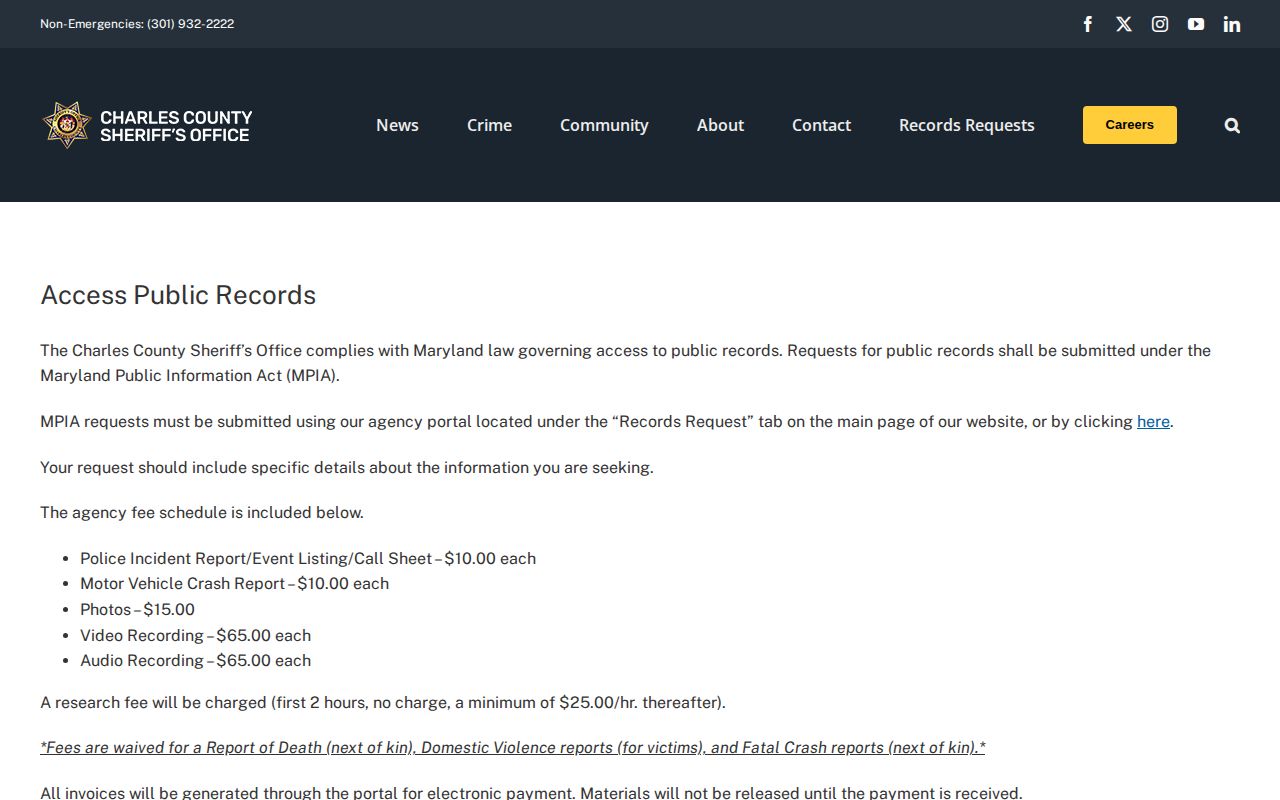
The portal is the documentary fallback when Charles County has no public released-person feed.
Charles County Release Access Laws
Maryland’s Public Information Act, General Provisions §§4-101 through 4-601, covers existing public records in forms that include photographs and electronic material. It does not force an agency to answer a question, conduct new research, or make a record that does not exist. Custodians must also apply privacy, confidentiality, privilege, investigatory, and public-interest rules. That is why a precise request for an existing Charles County release entry works better than a request to create a 24-hour list.
Online visibility and public access are not identical. Expunged, shielded, sealed, juvenile, and other protected matters may be unavailable as law requires. Some favorable criminal outcomes disappear from remote Case Search while a lawful courthouse record remains. Conversely, ordinary release does not erase a booking or case. Verify the access status with the record’s custodian instead of treating search failure as proof that no record exists.
A person missing from a roster or locator is not confirmed released. Use a discharge record, custody notice, court file, or receiving-agency record.
Charles County Commissioner Release Orders
The District Court Commissioner station at 11 Washington Avenue in La Plata is listed for service around the clock. A commissioner can make a pretrial release decision. Local CCSO accounts also document cases involving unsecured bond and electronic-monitoring conditions. These are useful evidence of the legal authority, but they are not a CCDC discharge timestamp.
Keep three times separate: the court’s authorization, the detention center’s actual discharge, and a receiving agency’s intake when a transfer occurs. A VINE status change or a CCDC release entry can close the gap between the order and the physical exit. If another hold exists, an order in one case may not free the person.
Charles County Booking Counts Differ
Two official 2024 sources use different measures. The CCSO annual report lists 5,187 intake arrests, 1,560 individuals booked, and an average daily population of 218. A detainee-communications procurement lists 5,298 “bookings” and an average daily population of 180. The labels and contexts differ, so neither set should overwrite the other.
None is a release count. The numbers cannot support an inferred average stay or a claim about how many Charles County inmates left custody. They remain source-specific operating measures.
Find Charles County Released Inmates
Charles County publishes no verified current jail roster, historical released-inmate database, or rolling release list. A reliable search therefore tests each possible custody transition. Start with the last known custodian and known identifiers. Then compare direct custody, court, notification, and documentary sources. The Charles County jail releases for 24 hours route explains the same-day fallback when timing is the main concern.
- Identify whether the last known system was CCDC, Maryland DOC, federal custody, or ICE. Gather a full name, birth date, number, case, and approximate date.
- Search Maryland VINE by name or offender number. Read the stated custody result and re-register after a move between local jail, state prison, court levels, or supervision.
- Check the correct current-custody locator. A DPSCS match after a CCDC exit points to state transfer, while no match proves nothing by itself.
- Read the Maryland court docket for bond review, release conditions, commitment, disposition, sentence, modification, and probation entries.
- Call CCDC or the relevant custodian. Ask whether the person remains held and, if disclosable, whether the exit was release or transfer.
- Request the release or discharge entry when proof is needed. Use separate CCSO, DPSCS, court, federal, or immigration routes.
- Check parole, probation, or mandatory supervision only when the sentence or order makes that system relevant.
A strong result describes evidence at its proper level. A court order authorizes action. VINE reports a custody event. A jail discharge entry records an agency release. A locator disappearance is just a clue.
Charles County DOC Custody Check
The Maryland DPSCS Incarcerated Individual Locator is a present-housing tool. It searches first and last name for people currently housed in covered state facilities. DPSCS expressly excludes people no longer in custody for any reason, including release or escape, and it may omit some short-sentence placements. It has no historical released status, discharge date, projected date, supervision status, or supervising-office field.
| Field or outcome | What it means |
|---|---|
| First name | Search input for a person currently housed |
| Last name | Search input; verified spelling variants may help |
| Housing location | Evidence of current covered state custody |
| No result | Inconclusive; may reflect release, omission, escape, mismatch, or no state custody |
The official page’s limits are visible in the DPSCS locator capture.
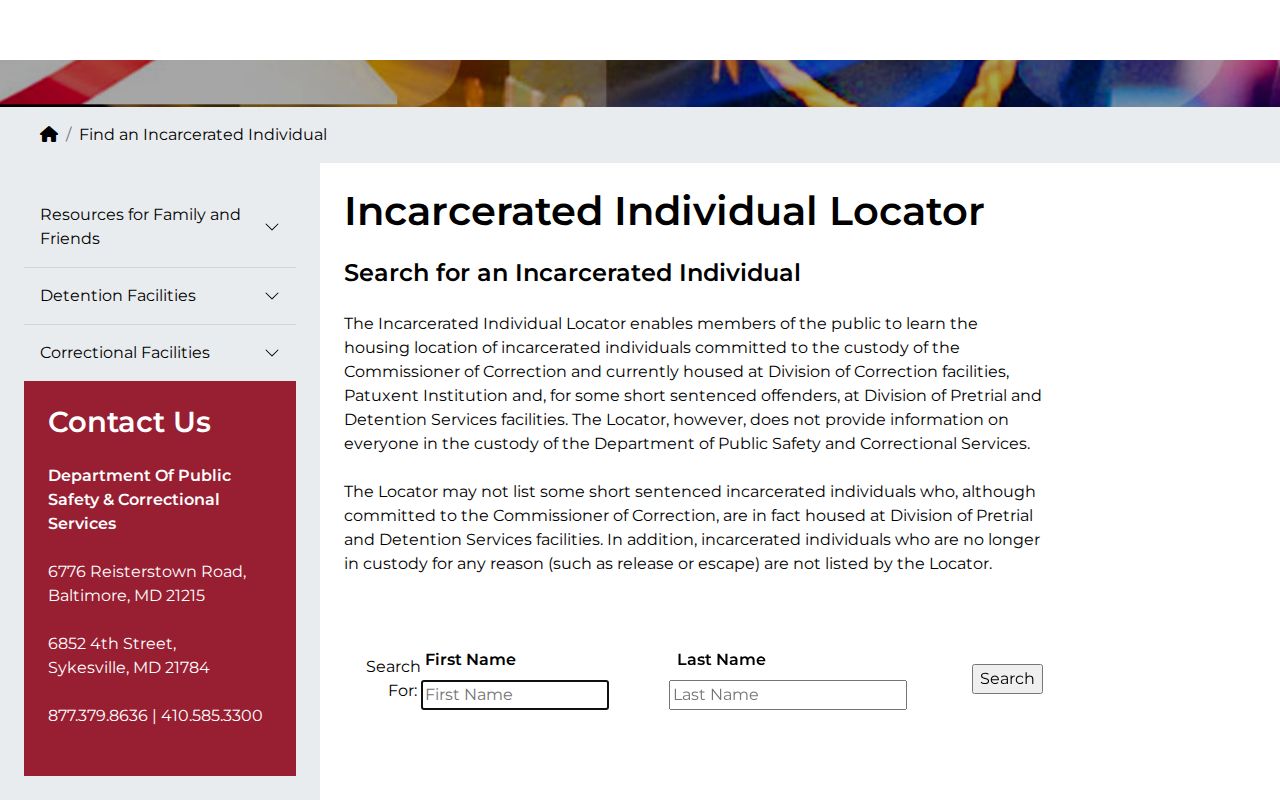
A current state match after departure from CCDC indicates continuing custody, not a Charles County community release. For a past state discharge, use VINE, the MPC or court record, the releasing institution, or a focused DPSCS PIA request.
No Charles County Release Feed
CCSO’s official detention, division, records, press, and navigation pages expose no verified roster, 24-hour release view, 72-hour release view, archive, update cadence, photo display, or retention window. The detention page links to services used by people still held, but those tools do not confirm release. Unrelated third-party booking pages answer a different question and should not be presented as county release sources.
The official Charles County Detention Center page is documented in the manifest capture.
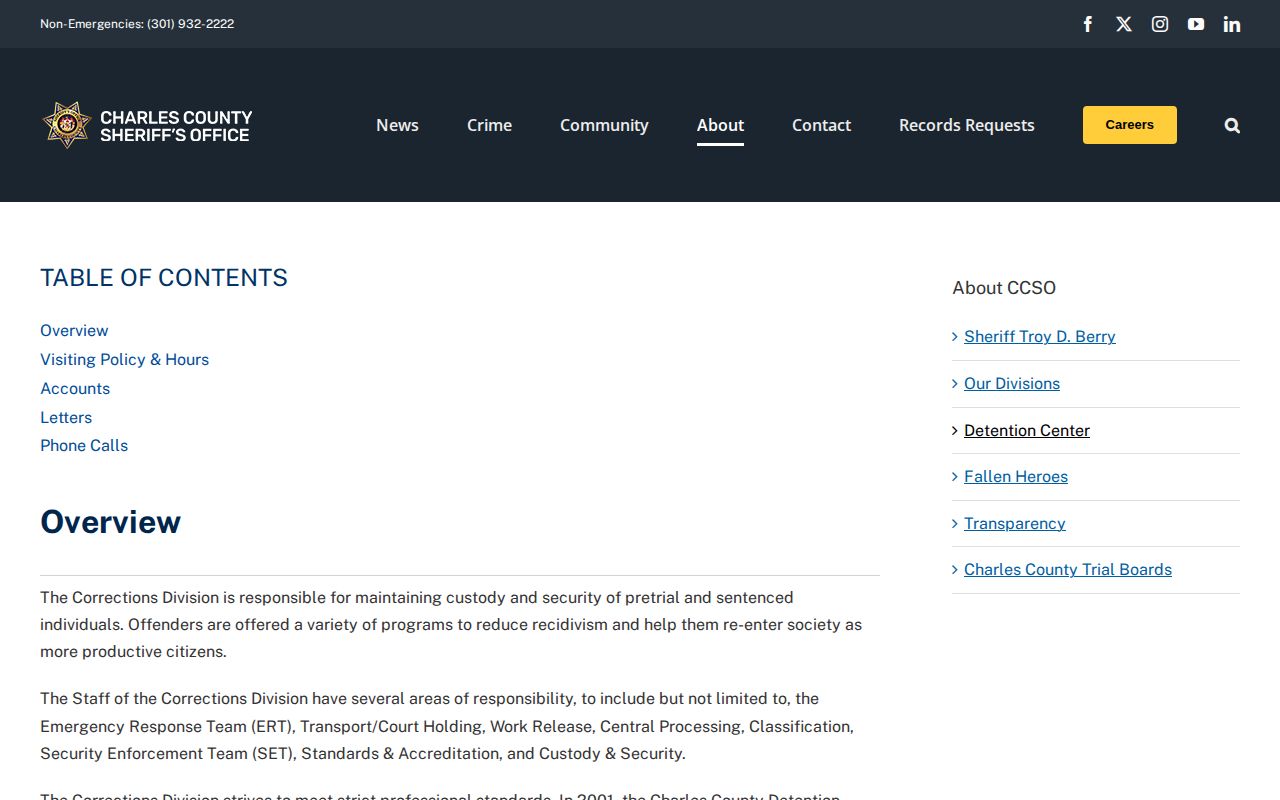
Its lack of release controls makes the CCDC phone, VINE, court docket, and CCSO records portal the practical fallback chain.
CCSO also has no verified jail-information app. Cordico serves employee and family wellness, while P3 accepts tips. Neither supplies Charles County inmate or release data.
Charles County Release Supervision
Maryland separates release decisions from field supervision. The Maryland Parole Commission decides parole and revocation matters. The Division of Parole and Probation supervises people on parole, probation, and mandatory release. There is no verified public DPP person-name search for a Charles County supervisee. Maryland law requires the parole order to be filed with the sentencing court, so the court file is a durable starting point.
The Waldorf Field Office at 25 Industrial Park Drive serves the local area. Callers may ask which office handles a known matter or how to provide relevant information, but staff disclosure may be limited. No current public Charles County absconder list was found. Absconding means an alleged failure to remain under supervision and can lead to a warrant or revocation; it does not mean discharge. The dedicated Charles County probation and parole record path covers orders, hearings, and supervision contacts.
Charles County Release Program History
Historical and current CCSO detention material mentions Successful Transitioning and Reentry Skills, GED work, reentry fairs, and work or school release. Current material keeps broader program language, but the former Annex account says the work-release program there ended before the building became a patrol station. That history should not be advertised as a current service.
Anyone planning for a Charles County discharge should confirm current program availability and eligibility with CCDC. Older agency reports can explain a past release record, yet they do not prove that the same program operates now.
Charles County Court Record Gaps
Maryland Judiciary Case Search guidance says the portal defaults to exact-name searching and directs users to add a trailing percent sign for a partial name. Charles Circuit criminal electronic data begins October 26, 1998, and portal data appears soon after clerk entry. Even so, a summary is not the complete case file. A favorable disposition may leave remote display while a public courthouse record remains available.
Nolle prosequi, dismissal, and acquittal or not-guilty entries may require a clerk check. A stet drops from remote display after three years. Expunged, sealed, shielded, juvenile, and otherwise protected records are unavailable as the law provides. For Charles County release verification, obtain the exact bond order, release condition, sentence, commitment, modification, or disposition from the court that maintains the case.
Charles County Federal Release Paths
Maryland VINE is available online, by app, and by phone at 1-866-634-8463. It can report custody, court, protective-order, and described probation or parole events. Search the named person, compare identifiers, read only the status shown, and register again when the case changes court level or custody system. VINE and written DOC Victim Services notification are separate registrations.
Federal and immigration systems require different tools. The BOP Inmate Locator can display a past federal release date and “RELEASED,” which means no longer in BOP custody. ICE’s locator covers current detention and people released from ICE custody during its stated recent window. USMS has no comparable public released-person search. None of those results proves the date or basis of the earlier CCDC exit.
The manifest capture shows how a past BOP release result differs from a local jail record.
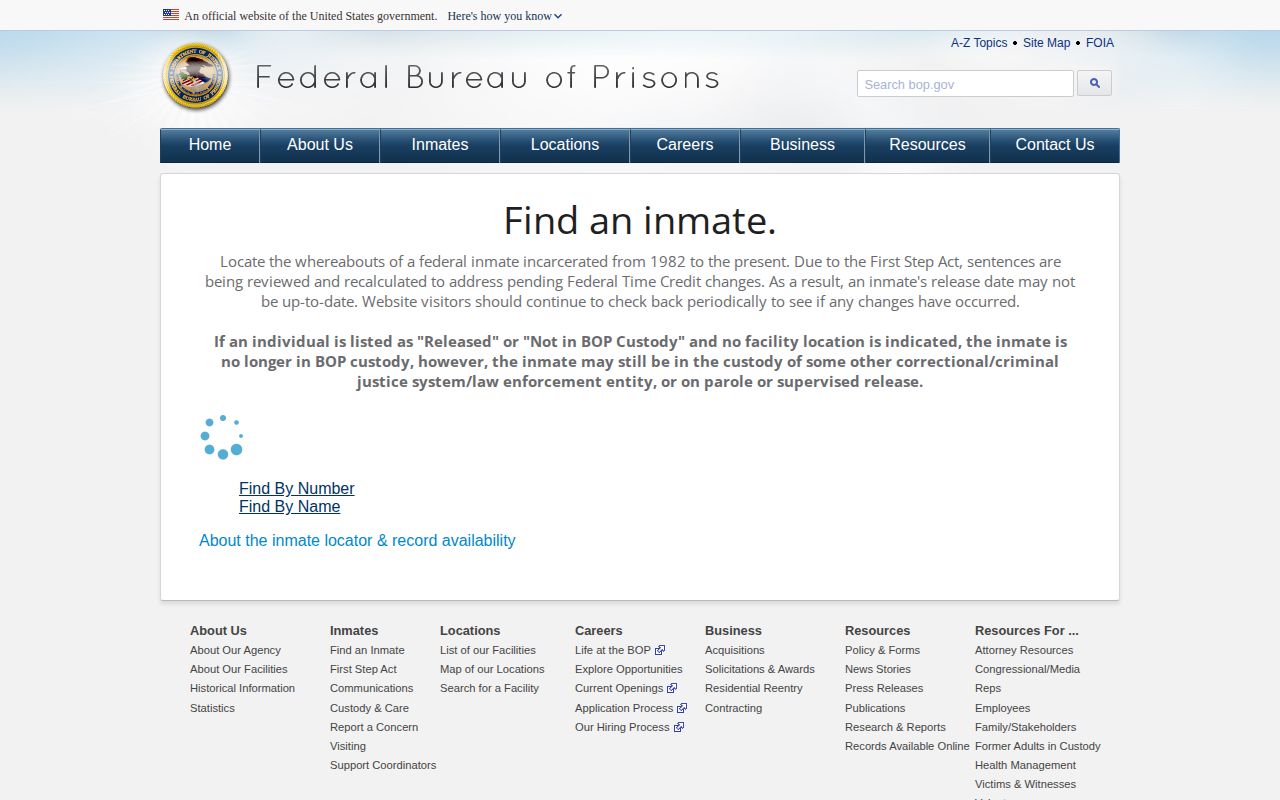
Federal release status must still be separated from supervision, state custody, immigration custody, or another open case.
Compare Charles County Release Status
The same name can move through several systems. Pick the source that matches the last known custody and the question being asked.
| Source | Best evidence | Key limit |
|---|---|---|
| CCDC custody inquiry | Whether the person remains at the county jail | Public details may be limited |
| CCSO release record | County booking and actual discharge event | Requires a records request |
| DPSCS locator | Current covered Maryland state housing | No released history or projected date |
| VINE | Custody status, release data, and alerts | Coverage can change at system boundaries |
| Maryland court file | Release authority, sentence, and disposition | An order may precede physical discharge |
| BOP or ICE locator | Custody within that federal system | Does not document the CCDC exit |
When results conflict, favor the source closest to the event and ask for its record. A receiving-agency intake can show that a Charles County departure was a transfer. An actual discharge entry is stronger than an inference from absence.
Charles County Annex Release History
The current CCDC opened in 1995. The earlier county jail operated from 1981 to 1995, reopened as an Annex in 2007, later housed work-release activity, and is now South Patrol District One. The work-release program there ended before the conversion. An old record that says “Annex” points to an archival facility reference, not a second operating Charles County jail.
Use the historical facility name and approximate date in a CCSO records request. Do not call the former Annex to locate someone now. Current custody questions belong with CCDC or the agency that received the person.
Charles County Release Expungement Help
The Maryland Judiciary expungement guidance identifies the La Plata District Court Help Center at 200 Charles Street for free limited help during posted weekday hours. Maryland distinguishes petitions tied to favorable dispositions, eligible guilty dispositions, and earlier removal of qualifying all-favorable cases. The Judiciary currently lists no filing fee for form CC-DC-CR-072A, a $30 nonrefundable per-case fee for eligible forms 072B or 072D, and no fee for 072C.
Qualifying cases in which all charges ended in acquittal, not guilty, dismissal, or nolle prosequi on or after October 1, 2021 are automatically expunged after three years; form 072C can seek earlier action. Eligibility and access depend on the current official rules. Ordinary release alone does not expunge a Charles County booking or court record.
Charles County Release Care Planning
CCDC’s health-services procurement requires need-based discharge continuity work. The contractor must address transition planning, community-clinician referrals, exchange of relevant health information, appointments or prescriptions, and up to a 14-day medication supply where needed. These are contract requirements, not a promise that every released person receives every item.
For a planned Charles County release involving ongoing care, ask the facility what applies to that person and when arrangements will be available. Exact release processing times, exit doors, family waiting practices, property return, transportation, and weekend procedures were not published and should not be assumed.
Charles County Release Systems
The Charles County Detention Center is the only verified active adult correctional facility physically in the county. The former Annex is historical. No Maryland prison, federal prison, or official ICE detention center was verified inside Charles County, but each outside system can receive a transfer from CCDC. Their pages describe the correct custody lane without implying a local physical institution.
- Charles County Detention Center for current county custody and CCDC release records.
- Former Charles County Detention Center Annex for historical record references.
- Maryland State Correctional Facilities for a transfer into covered state custody.
- Federal Custody Serving Charles County for BOP and USMS paths.
- ICE Detention Serving Charles County for current or recent immigration custody.
Each lane records a different event. Confirm the destination instead of treating departure from CCDC as proof of release to the community.