
Charles County 72-Hour Releases
No official CCSO page provides a rolling 72-hour list of people released from the Charles County Detention Center. Searches of the sheriff’s detention, divisions, public-records, press-release, and current navigation pages found no roster or recent-release control. As a result, Charles County publishes no three-day window, field list, update cadence, booking-photo display, or post-release retention rule for such a feed.
A three-day inquiry must be assembled from event records. VINE may show a custody change. Maryland Judiciary Case Search may show the order that allowed release. CCDC can address present custody, subject to what staff may disclose. A CCSO discharge record can document the county jail exit. Each source answers a different question, so agreement among them is stronger than any single missing search result.
A booking list records entry into custody. It cannot prove an exit. Likewise, a missing name from an unrelated site does not establish a community release from Charles County.
Check Charles County Three-Day Releases
Choose a start and end date before searching. A fixed three-day span is clearer than “recent,” especially when events cross midnight. Record the person’s full name, date of birth if known, approximate arrest or booking date, case number, and any CCDC booking number. The same identifiers should be used across VINE, the court docket, facility inquiry, and records request.
- Search Maryland VINE for the named person, compare identifiers, and note any custody or release event within the chosen span.
- Review the matching Charles County case in Maryland Judiciary Case Search for bond review, release conditions, disposition, sentencing, probation, or a commitment order.
- Call CCDC at 301-932-3101 or 301-932-3100 and ask whether the person remains confined and whether a disclosed exit was release or transfer.
- Submit a focused CCSO request for the existing booking and discharge portions covering that person and date range.
- Check the appropriate receiving system when the record suggests Maryland DOC, federal, or immigration custody.
Recheck the sources rather than widening the range without a reason. A court entry may appear first, followed by a VINE event and then a formal record. The order matters because legal authorization and physical discharge are not the same step. For a same-day question, the Charles County Jail Releases: 24 Hours process gives a tighter sequence.
Note: Preserve the exact date range used so the later records request describes one clear custody episode.
Charles County 72-Hour Record Fields
There are no public CCSO feed fields to display. A useful three-day record request instead names the existing data points that can confirm a jail exit. Not every item is guaranteed to exist or be disclosed. Charles County has not published a discharge-record field dictionary, and Maryland law permits or requires withholding in some cases.
| Record detail | Use within the 72-hour check |
|---|---|
| Person and booking number | Connects the response to the correct CCDC custody episode. |
| Admission date and time | Separates an older booking from the three-day event being reviewed. |
| Discharge date and time | Identifies the recorded county jail exit within the defined span. |
| Release authority or type | May identify bond, personal recognizance, electronic monitoring, time served, sentence expiration, dismissal, or another basis. |
| Destination or receiving agency | Distinguishes community release from continued custody elsewhere. |
| Case or court number | Points to the matching order, docket entry, or disposition. |
The correct wording asks CCSO for the booking, release, or disposition portions of records already held. It should not demand that staff compile a new countywide 72-hour list. If confidential details are mixed with releasable facts, request the nonexempt portions that can be segregated. That keeps the request tied to the release event rather than to broad case material.
Weekends and Charles County Releases
A three-day span is often chosen because it crosses a weekend or holiday, but Charles County publishes no special weekend discharge schedule. Exact release-processing times, exit doors, family waiting rules, rideshare practices, property procedures, and holiday staffing were not verified. Avoid predicting when someone will walk out based only on a court event.
The safest method separates the court authorization time from the jail discharge time. A commissioner may authorize bond or electronic monitoring while the person remains at CCDC for processing. A detainer can prevent community release. A transport order may send the person to another custodian. When the three-day period crosses a nonbusiness day, VINE and direct CCDC confirmation can provide a timely custody check, while the record request supplies documentary proof later.
Charles County court offices have posted business hours, but the District Court Commissioner directory indicates continuous service. That means a release decision can occur outside ordinary clerk hours. It does not establish CCDC’s discharge time. The actual county release record remains the key event document.
Note: Never infer a weekend release time from a court order alone; confirm the completed discharge or transfer.
Charles County Release Feed Gap
The current CCSO detention page publishes facility and detainee-service information, but it has no 24-hour or 72-hour release control. This is not a hidden filter. No exact feed URL or release archive was verified. The lack of a public roster also means there is no stated period during which a released name remains visible.
That absence makes the CCSO records portal and Maryland VINE unusually important for Charles County. A third-party “72 hour booking” source answers a different question and must not be treated as a sheriff release feed. Arrest, intake, and booking mark entry into custody. Release, discharge, or transfer marks movement out of CCDC.
The official records page shows the portal route and current published fee categories used for a focused request.
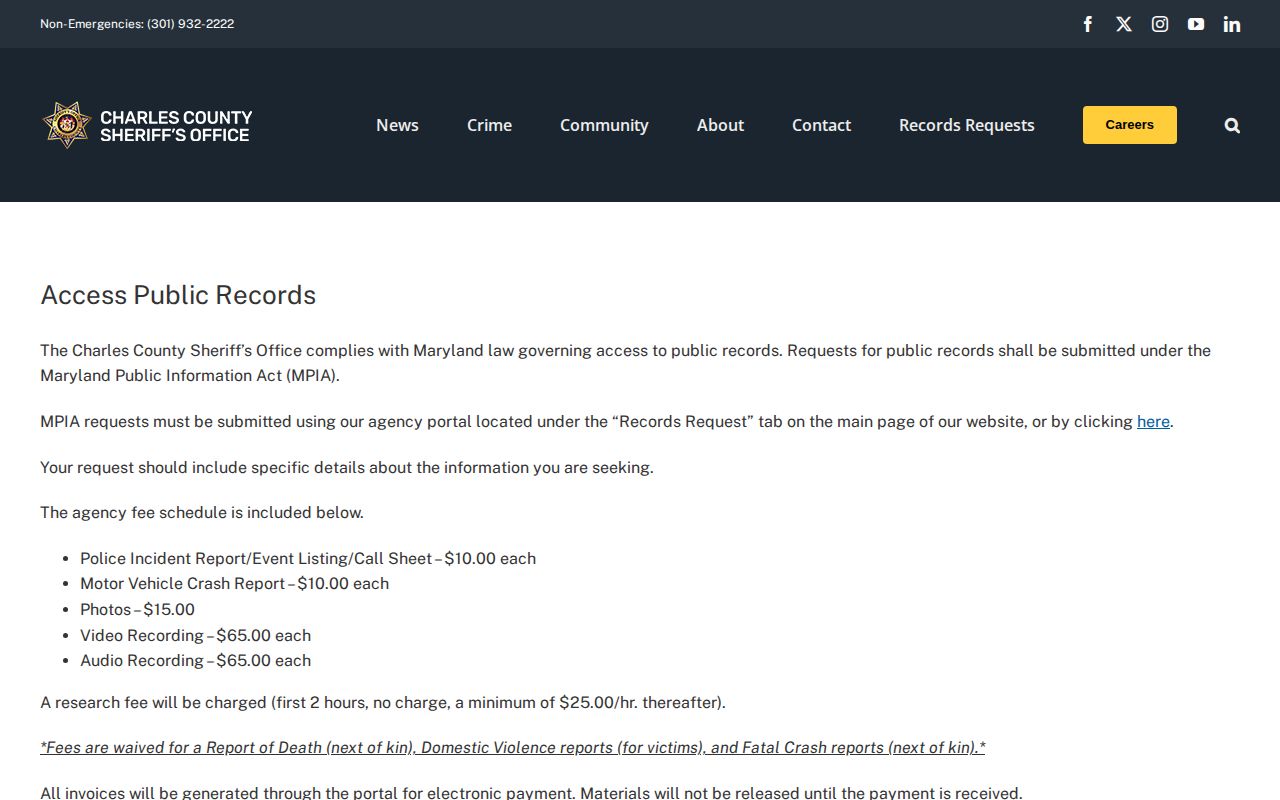
The screenshot supports a date-range records strategy rather than an invented three-day roster. It also shows why a requester should describe the exact record needed before any invoice is prepared.
Request Charles County Release Records
Use the CCSO Access Public Records page and its agency portal for CCDC records. Identify one person, the detention center, the approximate booking date, and the exact three-day span. Include a date of birth, booking number, or case number when known. Ask for the existing intake and discharge entries, release date and time, release type or authority, and destination or receiving agency if those details are maintained.
CCSO’s Records Section can be reached at 301-609-6404. Headquarters is listed at 6915 Crain Highway, P.O. Box 189, La Plata, MD 20646. Current published categories price incident reports or event listings, photographs, audio, video, and research time. They do not establish a flat fee for a release record. The first two hours of research are published as free, after which a minimum hourly research charge may apply. CCSO gives no current official turnaround or detention-record retention period.
Under Maryland’s Public Information Act, an agency responds to records it already keeps. It need not create a custom 72-hour report or answer open-ended questions. Electronic delivery and a request for segregable nonexempt portions can make the scope clear. The portal generates an invoice when fees apply, and payment precedes release of the material.
Charles County Release Status Across Systems
A CCDC exit does not always end custody. A person may enter the community through bond, personal recognizance, electronic monitoring, time served, sentence expiration, dismissal, or another court-authorized status. The same jail exit may instead lead to a Maryland prison, another county, federal custody, or immigration detention. A hospital move can occur while legal custody continues.
| Source | What a result can establish | What it cannot establish alone |
|---|---|---|
| Maryland VINE | A reported custody or release status event for the matched person. | A complete certified CCDC discharge record. |
| Charles County court docket | The legal order, bond terms, disposition, sentence, or probation entry. | The exact time jail staff completed discharge. |
| DPSCS locator | Current housing in covered Maryland state facilities. | A historical state release or a county discharge. |
| BOP or ICE locator | Information within the federal or immigration system’s stated scope. | The reason and time of the earlier CCDC exit. |
| CCSO release record | The county jail event and, when maintained, its authority and destination. | Later events controlled by a receiving agency. |
The Maryland DPSCS public locator is current-custody oriented. A state hit after someone leaves CCDC suggests transfer into continued custody. No result remains inconclusive because the locator omits people no longer in covered custody and some short sentences. BOP and ICE use separate rules. The full Charles County released inmate lookup is the better route when the last known custodial system is unclear.
Evidence should be described at its actual strength. A VINE event or jail response addresses present or changed custody. A formal discharge entry documents the agency event. A court order supports legal authority. A press item or missing locator result is only a lead until reconciled with one of those records.