
Charles County Projected Release Dates
A projected date is an agency calculation based on the information then in force. An actual release date is the event recorded when the custodial agency completes the person's exit or transfer. Those dates may match, but they are not interchangeable. A projection can move as sentence credit is earned, revoked, or restored. A new consecutive sentence, warrant, detainer, parole action, or amended court order may also alter the result.
Pretrial detention works differently. A Charles County judge or District Court Commissioner may authorize personal recognizance, bond, electronic monitoring, or another status, yet that order is not the CCDC gate timestamp. Staff still process the release and check for other holds. A pretrial person awaiting a court decision has no sentence-based projected date. For both sentenced and pretrial cases, absence from a roster or locator cannot establish the actual out date.
No Charles County Release Calculator
The Maryland Department of Public Safety and Correctional Services calls its public search the Incarcerated Individual Locator. It accepts first and last names and reports the housing location of people currently held in covered state facilities. DPSCS expressly excludes people no longer in custody for any reason. The interface has no projected, tentative, maximum, or mandatory release-date field. It also has no released or discharged historical profile.
CCDC likewise publishes no county-jail projected-date calculator. Therefore, a truthful Charles County projected release search cannot promise an online answer. The public state locator can test whether the person is currently housed in the covered state system. It cannot reveal the date on which a sentence calculation expects release. A no-result cannot distinguish release, escape, an omitted short sentence, a name mismatch, or absence from Maryland DOC custody.
The official DPSCS locator page shows the search form and its current-custody limitation.
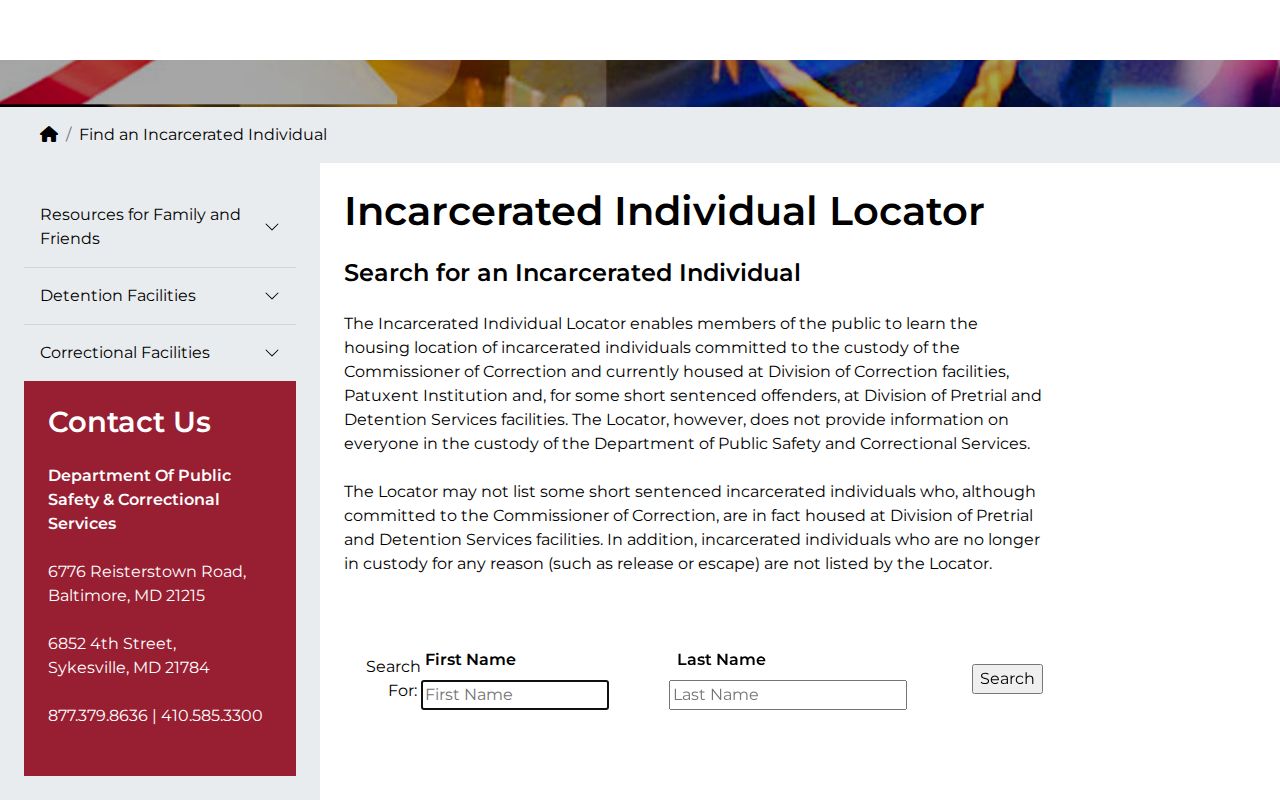
That limitation is the reason the sentence, credit ledger, court order, and release record must carry the date inquiry.
Find a Charles County Release Date
Begin by identifying whether the last known custody was CCDC or Maryland DOC. Use the exact case and commitment identifiers whenever possible. The sentencing order establishes the term. Judicial credit accounts for qualifying time already spent in custody. The custodial agency then applies the credit rules that fit the sentence and tracks later changes. A projected date copied from an old letter should be checked against the current agency calculation.
- Match the person to the Charles County court case by full name, date of birth, and case number.
- Obtain the sentencing or commitment order, including concurrent or consecutive terms, mandatory portions, and credit for time served.
- Determine the responsible custodian. CCDC handles local detention records; DPSCS handles state commitment and correctional records.
- For current state housing, use the DPSCS locator only to confirm the facility, then request the sentence and credit calculation from the responsible state channel.
- For a county sentence, ask CCSO or CCDC for the commitment, judicial credit, jail credit ledger, and existing projected or discharge entry.
- Check for new orders, detainers, warrants, parole decisions, or consecutive cases that may change the computation.
- Confirm the completed exit through VINE or the actual release record when the date arrives.
The Charles County released-inmate records workflow provides the broader route for requesting a CCDC discharge entry. For a state case, DPSCS PIA, the releasing institution, or the Case Management Office for Operations may hold the existing commitment or release material. Ask for records, not for the agency to create a new explanation.
Note: DOC Data Processing answers current-custody questions, but it is not a public projected-date or past-release search.
Maryland Credits Change Release Dates
Maryland calls sentence reductions diminution credits. For covered state terms, Correctional Services §3-704 generally awards good-conduct credit in advance at ten days per calendar month. The rate is five days per month when the term includes a concurrent or consecutive sentence for a statutory crime of violence or specified controlled-dangerous-substance offenses. Partial months are prorated. The statute also limits credit during escape or noncustody and on stayed sentences as specified.
Other provisions add credits for defined activity. Section 3-705 permits five days per month for satisfactory work. Section 3-706 permits five days per month for satisfactory progress or completion in listed education, vocational, cognitive, substance-use, life-skills, antiviolence, or workforce programs. Section 3-707 allows special-project or program credits of up to twenty days per month, reduced to ten for specified offense groups.
Section 3-706.1 separately addresses milestone credits. It awards sixty days for a qualifying academic or vocational achievement, or forty days when the term is for a crime of violence, subject to statutory exclusions. Section 3-708 caps combined monthly deductions other than the milestone credit at twenty days for the restricted group defined through §3-707 and thirty days for others.
Charles County Jail Sentence Credits
County sentences use a related but different statutory framework. Local correctional facility credits are governed mainly by Correctional Services Title 11, Subtitle 5. Section 11-502 addresses eligibility and exclusions. Sections 11-503 and 11-504 concern presentence and postsentence good conduct. Sections 11-505 and 11-506 cover work and special projects, while §11-507 governs revocation with due process. Criminal Procedure §6-218 provides credit for qualifying time already spent in custody.
These laws do not produce a safe public calculator. CCDC has not published an individual computation tool or a county-specific implementation guide. The needed Charles County records are the commitment, the court's judicial credit, the local jail credit ledger, later revocation or restoration entries, and the actual discharge record. A person with several cases may have concurrent terms, which run together, or consecutive terms, which run one after another. The court documents must resolve that point before a date is estimated.
- Judicial credit
- Qualifying time already spent in custody that the court applies to the sentence.
- Diminution credit
- A statutory sentence deduction tied to conduct, work, programs, or milestones.
- Concurrent term
- A sentence ordered to run at the same time as another term.
- Consecutive term
- A sentence ordered to begin after another term.
- Detainer
- A hold or request that may lead to continued custody or transfer.
Charles County Mandatory Release Dates
Correctional Services §7-501 directs DOC to conditionally release a qualifying person serving more than eighteen months when the term, less applicable Title 3 and Title 11 credits, has been served. For a crime of violence committed on or after October 1, 2009, conditional release cannot occur before the parole eligibility point specified by law. This status is mandatory supervision. It is not unconditional discharge from the sentence.
Parole is a separate route. The Maryland Parole Commission may approve conditional release under the rules governing the particular sentence. Approval can have a future date and may depend on a home plan or programs. It is not proof of same-day physical exit. A Charles County VINELink release alert can help mark the custody event, while the Commission, DOC, and court documents explain the authority and continuing supervision.
Maryland Has No Blanket 85%
Maryland does not impose a universal rule that every incarcerated person must serve about eighty-five percent of the sentence. A 2018 Department of Legislative Services fiscal note comparing jurisdictions stated that Maryland was not among states using that general approach. Applying an across-the-board percentage to a Charles County sentence would ignore the actual offense, parole rules, mandatory or no-parole portions, judicial credit, and available diminution credits.
The correct method begins with the aggregate sentence. Next come prior-custody credit, mandatory restrictions, the correct good-conduct rate, and later earned work, program, or milestone credit within statutory caps. The calculation must then account for revoked or restored credits, new sentences, and parole action. Even a careful estimate remains a projection until the responsible agency verifies it.
What Changes Charles County Release Dates
A release date can move forward or backward. Some changes arise from conduct and programming. Others come from a new legal event. The table identifies the kind of record needed to check each change without assuming that the old projection still controls.
| Change | Possible effect | Record to check |
|---|---|---|
| Earned work, program, or milestone credit | May move a qualifying projected date earlier within the statutory rules. | Current DOC or local credit ledger. |
| Discipline or credit revocation | May move the projection later; restoration may later alter it again. | Agency adjustment and disciplinary record. |
| New or consecutive sentence | Can extend the aggregate term. | New judgment and updated commitment calculation. |
| Amended court order or corrected credit | Can change the base term or time already credited. | Signed court order and revised agency ledger. |
| Parole approval, suspension, or revocation | Can create, delay, cancel, or end conditional release. | MPC decision, DOC event, and supervision record. |
| Warrant or detainer | May prevent community release and lead to transfer or continued custody. | Issuing court or receiving-agency record. |
A parole return has a further credit consequence in some cases. Section 3-711 bars applying pre-parole credits on return to DOC when a person is convicted and sentenced for a crime committed while on parole and parole is revoked. Because facts control that rule, the current calculation must come from the responsible agency rather than a general estimate.
Note: Only the actual Charles County or state discharge entry proves the completed out date after all holds and changes are resolved.
Confirm Charles County Actual Release
When the projected day arrives, verify the event itself. VINE may report a custody change or release date. CCDC can answer a present-custody inquiry, subject to its disclosure practice. A narrow CCSO records request can seek the existing release date and time, release type or authority, and destination or receiving agency if recorded. For Maryland DOC, use the releasing institution, DPSCS records channel, and court or parole documents.
Keep authorization, projection, and discharge as separate timestamps. A court order can authorize release. An agency calculation can forecast it. The jail or prison release record shows what actually happened. If another agency takes custody, the original facility exit is a transfer rather than a community release. That final distinction is essential in Charles County because neither the state locator nor CCDC publishes a historical release database.